
Weekend Birding: Mourning Doves
Mourning Doves are a common backyard bird and most days I see a few of them, occasionally sitting in the tray feeder but more often walking around on the ground picking up seeds. One afternoon a flock of them were in the yard and when I went outside they all flew away. But when I looked up I realized they hadn’t gone very far.
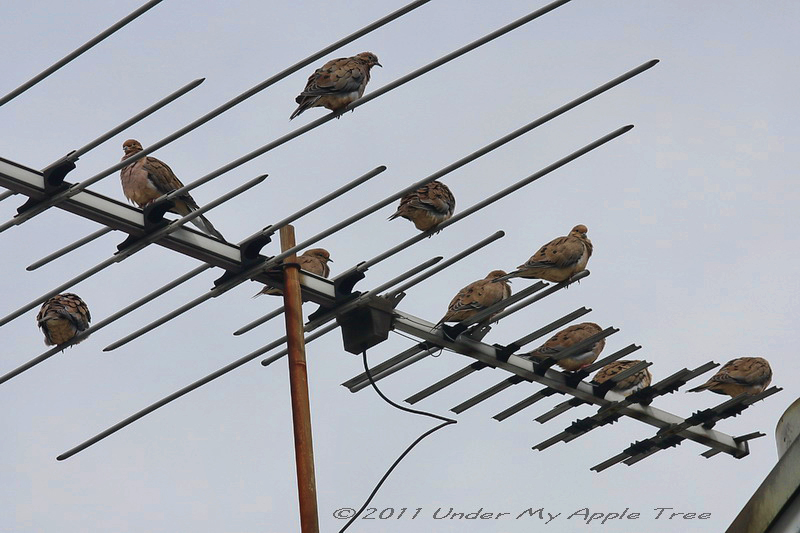
They were roosting on the roof antenna waiting for me to leave. They may have been using it as a giant perch for a while and I just never realized it. And of course I had to get a picture of it!
Mourning Doves are a common bird seen across most of North America. The Doves that breed in the northernmost areas will migrate south for the winter, sometimes thousands of miles. Those in central and southern US will only move a few hundred miles or may stay year round.
I have Mourning Doves here all winter. If they can find food they will remain even though it gets cold. They readily eat cracked corn, sunflower seed, nuts, milo and thistle, all seeds I put in the tray feeder.
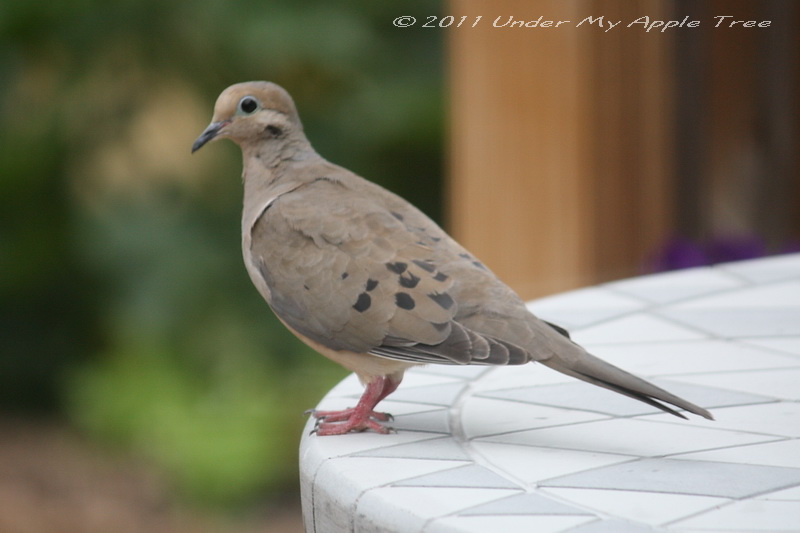 Interesting Facts:
- Mourning Doves eat roughly 12 to 20 percent of their body weight per day.
- The Mourning Dove is one of the most abundant birds with a U.S. population estimated at 350 million.
- The female builds the nest and will lay only 2 eggs. Both parents incubate the eggs.
- The whistling sound doves make when they fly is caused by air rapidly moving across their wings.
I link up my bird photos on Saturday Snapshot hosted by Alyce at At Home With Books. Visit her blog to see more great photos or add your own.


I was lucky enough to see Mourning Doves on my recent trip to the US. Interesting to learn more about them. What do you mean by milo seeds? Milo in Australia is a malted chocolate powder to put in milk- I don’t imagine that that’s what you’re putting out for the birds!
LikeLike
Milo is a type of seed that comes in the bag of mixed seeds I buy for the tray feeder. Doves, sparrows and any of the ground feeding birds like it, the other birds not so much.
I bet the starlings and grackles would eat chocolate powder if it was out there! They eat everything.
LikeLike
We have them in our back yard, too. They’re lovely. I also appreciate how serene they are as opposed to, say, starlings and blue jays.
LikeLike
That’s one bird I do recognize. I always feel lucky when I see one.
LikeLike
These do seem plentiful everywhere. I always see them as ground feeders as you mentioned.
(This morning I was shocked to see a HUGE blue jay here. I haven’t seen any since we moved here 2.5 years ago and they use to be everywhere).
LikeLike
Last year I started noticing Blue Jays in the yard again. They were one of the species hit hard by the West Nile virus.
LikeLike
Loved the photos!
We got so many around here. I love watching their antics..
Here is my Saturday Snapshot post!
LikeLike
I feel nostalgic when I hear them….they are definitely “mournful.” Thanks for sharing.
Here’s MY SATURDAY SNAPSHOT and
MY WEBSITE
LikeLike
We’ve had mourning doves here too. An apt name since their coo, coo sounds mournful.
LikeLike
I will have to pay attention and see if they stay around here for the winter.
LikeLike
You are a skilled photographer. I wish I had your talent and eye.
Anne@My Head is Full of Books
LikeLike
Beautiful – you always take such lovely pics!
LikeLike
I saw doves in our neighborhood for the first time a couple of weeks ago. I wonder if they were passing through because I haven’t seen them again since then.
LikeLike
I assume their call sounds mournful. What are they mourning? Perhaps they mourn for their relative, the Passenger Pigeon . . .
LikeLike
There is a large population of these in our area. Sadly, there’s a hunting season for them.
🙂
LikeLike
Awesome! We have a few of these visit our feeders every summer, but I’ve never seen a flock. That’s very cool. I love their cooing. Oh, and thanks for the info.
LikeLike