
The Canada Goose can be found throughout North America in both urban and suburban areas. They are familiar to most people and therefore need no introduction.
While walking around a small lake near my house I noticed a gosling and about 10 adult geese. They are not the friendliest birds and when nesting can be very territorial so I usually observe them from a distance.

These geese didn’t seem to mind me at all and I was able to get within a few feet of the little one. If they feel threatened or just don’t like the looks of you they will hiss and if you get too close they will bite.
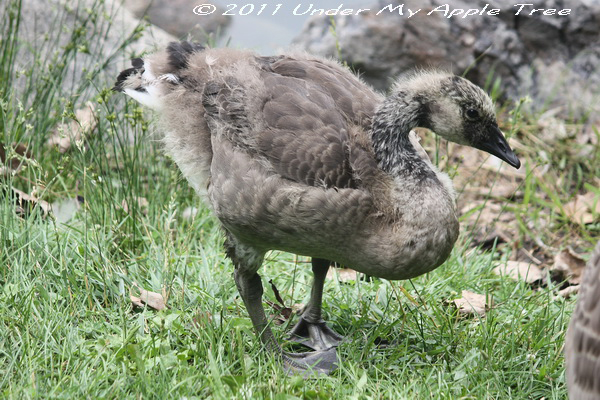
After allowing me to take a few pictures one of the adults gave a honk and they went into the water. I walked around the entire lake and this was the only youngster I saw. It’s unusual for geese to have only one chick as they generally lay 4 to 6 eggs.

The young often remain with their parents for their entire first year before going off on their own.
Last spring I found a pair of geese nesting in a flower box along the Chicago River and posted pictures on my garden blog. I took the photos with my phone but they are good enough to show what an adaptable species these birds are.
For more bird photos check out my previous Weekend Birding posts.
I link up my bird photos on Saturday Snapshot hosted by Alyce at At Home With Books. Visit her blog to see more great photos or add your own.
Thanks to Doubleday Books, I have two copies of The Upright Piano Player to give away to my readers.
I’ve just started reading my copy. The story begins on a sorrowful note at the funeral of Henry’s grandson. Then we jump back in time a four and a half years to Henry’s retirement party, an incident on New Year’s Eve and a mysterious stranger that is following Henry.
I had to put the book down about a quarter through to work on a few other things but I’ll be picking it back up in the next few days and will have my review shortly. It already has the feel of a page turner as we peel away the layers of Henry’s life and learn what brought him to the events of the tragic first paragraphs.
Description from the publisher:
 The Upright Piano Player
by David Abbott
Genre: Psychological Thriller
Publisher: Doubleday / Nan A. Talese
Publish Date: June 7, 2011
Format: Hardcover | 272 pages
… as Henry faces retirement, his well-ordered life begins to unravel. His ex-wife is ill, his relationship with his son is strained to the point of estrangement, and on the eve of the new millennium he is the victim of a random violent act which soon escalates into a prolonged harassment. As his ex-wife’s illness becomes grave, it is apparent that there is little time to redress the mistakes of the past. But the man stalking Henry remains at large. Who is doing this? And why?
About The Author
David Abbott worked for forty years in the advertising industry as a copywriter and creative director. He was a founding partner of Abbott Mead Vickers BBDO, the United Kingdom’s largest advertising agency. The Upright Piano Player is his first novel, and he is at work on his second.
Giveaway Information
Contest is open to US addresses only, no PO Boxes. The book will be shipped by the publisher.
- To enter fill out the Entry Form. Comments are always welcome but you need to fill out the form to enter the drawing.
- The deadline for entry is July 24th, midnight, central time. I will draw 2 winners using random.org. Winners will be contacted by email and have 48 hours to respond with a mailing address.
Contest Now Closed
Winners: Mary (Bookfan) and Julie S.

——————————–
More Wordless Wednesday.
 Lost in Shangri-La
by Mitchell Zuckoff
Read by Mitchell Zuckoff
Genre: Non-Fiction
Publisher: Harper Audio
Publish Date: April 26, 2011
Format: Audible Audio Edition | 8 hours and 32 min.
Version: Unabridged
Rating: 4 of 5
On May 13, 1945, twenty four service men and women boarded an American transport plane ironically nick-named the Gremlin Special to go on a day trip sightseeing over a beautiful, tropical valley known as Shangri-La. This was supposed to be a fun filled day, a treat for a group of service people stationed at an army base in Dutch New Guinea. But poor visibility and clouds obscured the mountains as they arrived over the valley. The flight ended in tragedy as the plane crashed into a mountain side leaving only three survivors, two who were badly injured and burned. This is the true story of their survival and eventual rescue and the 46 days they spent in the jungle.
A little known incident in military history, this is an engaging account of endurance and perseverance. With access to military records, letters, journals, photos and interview with eyewitnesses, the author was able to piece together the events of those weeks into an exciting narrative which reads like an adventure story. Suspense builds as the survivors make their way through the jungle and encounter natives that may or may not be friendly while at the same time the Army is planning a dangerous rescue mission to get them safely back home.
I listed to the audiobook which was narrated by the author in a documentary-like style. While it was not presented in dramatic fashion, I found his reading pleasant and easy to listen to. This is a fascinating, well-researched true story that will capture your attention and keep you listening, or reading if you choose the book. The only downside to the audio vs the book is that you don’t get to see the photos, which in a real life story such as this one can enhance the understanding for the reader.
———————–
Source: I received a copy of the audiobook from HarperAudio for review.
Read-along
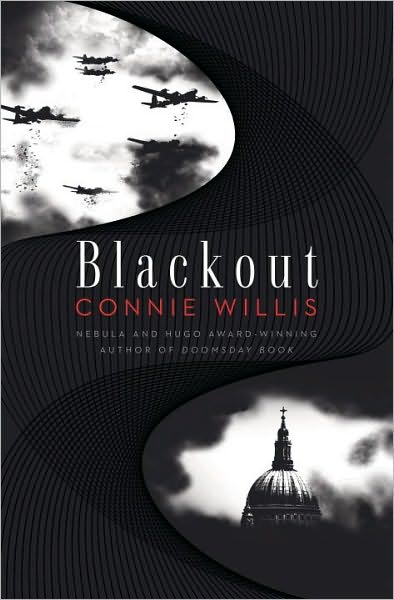 The read-along of Blackout by Connie Willis is now starting and will continue through the end of July. It is co-hosted by Carrie at Books and Movies and Avis at She Reads and Reads.
Connie Willis is one of my favorite authors. Blackout is both historical and science fiction: Oxford Historians travel back in time to World War II.
Connie Willis returns with a stunning, enormously entertaining novel of time travel, war, and the deeds—great and small—of ordinary people who shape history. In the hands of this acclaimed storyteller, the past and future collide—and the result is at once intriguing, elusive, and frightening.
It’s not too late to join in. Discussions begin July 9th. Read the announcement post and sign-up at Books and Movies.
Giveaway Winners

Col of Col Reads was the winner of the Literary Blog Hop Giveaway and will receive a copy of Doc by Mary Doria Russell.
Anna M. and Teawench were the winners of Prophecy by S. J. Harris.

Really Random Tuesday is hosted on random Tuesdays by Suko at Suko’s Notebook. It’s a way to post odds and ends–announcements, musings, quotes–any blogging and book-related things you can think of.
 Backyard Birds of North America
by Jonathan Alderfer and Paul Hess
Genre: Nature, Reference
Publisher: National Geographic Society
Publish Date: March, 2011
Format: Paperback, 256 pages
Rating: 4½ of 5
Serious birders have multiple field guides scattered around their house and in the car. Most of these types of field guides are too comprehensive for the casual bird watcher who just wants to know what kind of bird is at their feeder or singing that lovely song.
The guide I use the most is my National Geographic guide, so I’m a little partial to their newest version which is aimed at the backyard bird watcher. It focuses on the 150 most common species that one is likely to encounter in the yard or local park.
It’s nicely organized with plenty of illustrations and range maps, a description of the bird’s plumage, voice and nest type in a user friendly format. There is also a visual and color index to aid in initial identification of new birds. The first 50 pages of the book covers backyard basics: tips on identifying birds, what to feed them, placement of birdbaths and nestboxes, and types of plants/landscaping are recommeded to create a birding habitat. Interesting articles about bird behavior are included in the guide section with topics such as, “Why Do Birds Migrate”, “Feeder Pecking Order” and “How Do Birds Stay Warm”.
This is an excellent guide for the new or casual bird watcher. It does a nice job of highlighting most, but not all, of the birds you can find in your backyard or neighborhood park.
The White-breasted Nuthatch is another common North American bird found through most of the US, parts of Southern Canada and Mexico. They can often be found creeping down the trunk or large branches of old trees poking at the bark searching for insects. They turn upside down on vertical surfaces and walk down the tree as they forage.
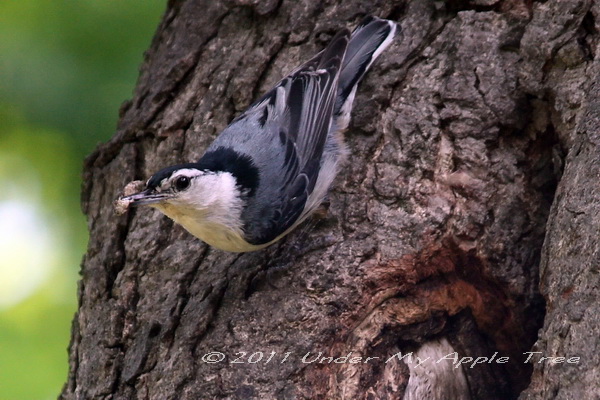
A few weeks ago I noticed a nuthatch going into a crevice in a old tree. Nuthatches nest in natural tree cavities or abandoned woodpecker holes. This bird was carrying insects into the crevice so I knew there were nestlings inside.
The female incubates the eggs but both parents take care of the young. It can be difficult to tell them apart because they look alike. The difference is the male has a black cap and the female’s is dark gray. I think this was the male bringing the food.
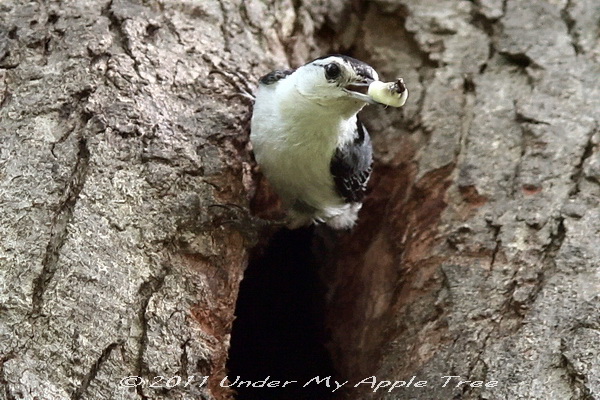
A nestling will poop every time it eats and the parents will remove it from the nest dropping it a short distance away. The waste material is contained in a “fecal sac”, a tough membrane, kind of like a diaper for birds. Here is one of the parents, I’m not sure which one, doing cleanup and exiting with a sac.
For more bird photos check out my previous Weekend Birding posts.
I link up my bird photos on Saturday Snapshot hosted by Alyce at At Home With Books. Visit her blog to see more great photos or add your own.


